A Complete Guide to Differences, Difficulty, and How to Choose
When people first start learning Chinese, they almost always face the same question:
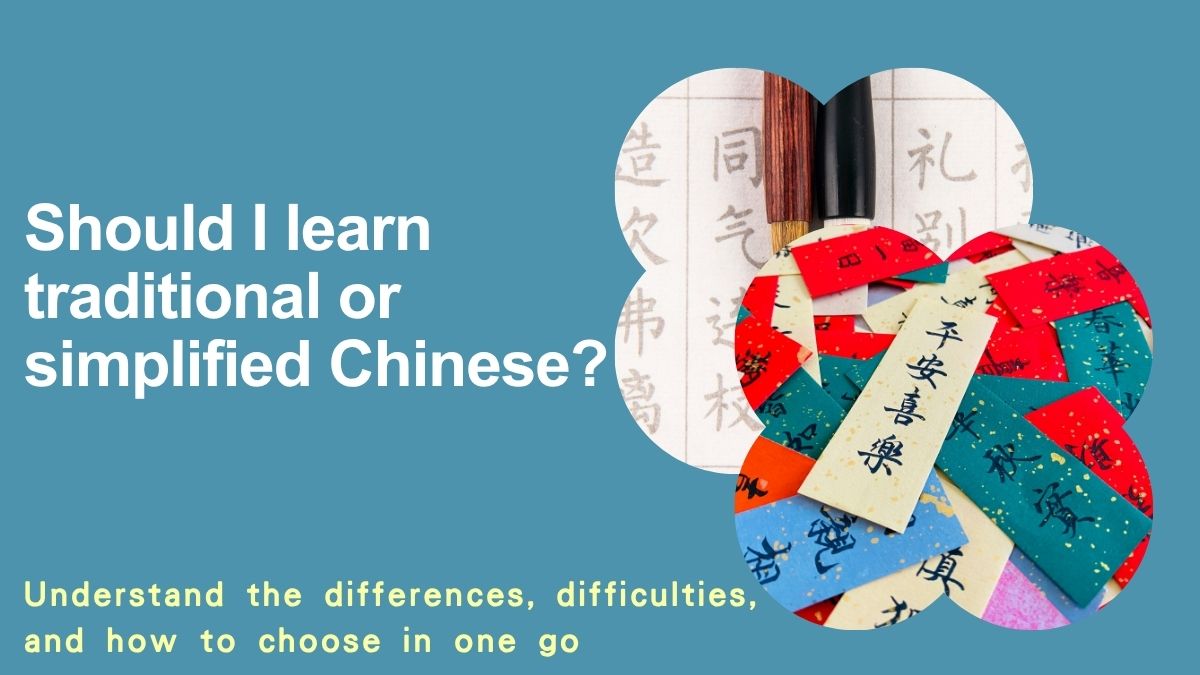
“Should I learn Traditional Chinese or Simplified Chinese?”
These two systems differ in regions, learning materials, exams, and even typing input methods. Choosing the wrong direction often leads to a frustrating realization after three or four months of study.
So before anything else, ask yourself this:
“Why am I learning Chinese, and who do I want to communicate with?”
This article addresses the most common questions from Chinese learners. It explains the differences between Traditional and Simplified Chinese, which one is more difficult, whether learning one helps you understand the other, and how to choose based on your situation.
If you’re still unsure, Oh Young Chinese Language Center offers free consultations to help you choose the right system from the very beginning and improve your learning efficiency.

1. What’s the Difference Between Traditional and Simplified Chinese?
In terms of spoken language, there is no difference. Both use Mandarin.
The only difference lies in written characters:
- Traditional Chinese: Used in Taiwan, Hong Kong, and Macau. Characters have more strokes and preserve more original structure.
- Simplified Chinese: Used in mainland China, Singapore, and Malaysia. Characters are simplified and faster to write.
Even from a few everyday characters, you can immediately notice the difference.
|
Meaning |
Traditional Chinese |
Simplified Chinese |
Difference description |
|
愛 |
愛 |
爱 |
Traditional Chinese contains the “heart” (心) component; Simplified Chinese removes it |
|
聽(listen) |
聽 |
听 |
Traditional includes the “ear” (耳) component; Simplified keeps only “mouth + axe” (口+斤) |
|
學(study) |
學 |
学 |
Traditional preserves a more complete upper structure; Simplified significantly reduces it |
|
龍 |
龍 |
龙 |
The visual difference is large, making it harder for beginners to recognize |
|
體(body) |
體 |
体 |
Traditional has more strokes; Simplified is clearly reduced |
|
東(east) |
東 |
东 |
Structural richness vs simplification |
However, the differences go beyond character forms.
Vocabulary usage also differs, which many learners overlook.
|
Meaning |
Traditional Chinese |
Simplified Chinese |
|
Subway / MRT |
捷運 |
地铁 |
|
Taxi |
計程車 |
出租车 |
|
Restroom |
廁所 / 洗手間 |
卫生间 |
|
Breakfast shop staff |
服務生 |
服务员 |
|
Internet |
網路 |
网络 |
|
Software |
軟體 |
软件 |
This means that even if you use conversion tools to switch between Traditional and Simplified characters, you still need to learn vocabulary differences separately. It’s not just about changing character shapes.

2. Which Is Harder to Learn?
This is the question most learners care about. The answer depends on perspective.
From a stroke-count perspective
Simplified Chinese is indeed easier.
It has fewer strokes, making it quicker to write and less visually overwhelming for beginners without any background in Chinese characters.
Many learners report feeling discouraged when they first see dense Traditional characters, which is why they often start with Simplified Chinese. However, switching later or deepening learning may take extra time.
From a memory perspective
Traditional Chinese is not necessarily harder.
Here’s a counterintuitive insight:
Traditional characters are based on ancient character formation principles (such as pictographs and phonetic compounds). Their structure often provides built-in memory clues, meaning you don’t have to rely solely on memorization.
Simplified characters follow the opposite logic. Characters are simplified first, then rules are applied afterward. As a result, although they look easier, the connection between form and meaning is weakened, forcing learners to rely more on repetition.
This difference may not be obvious with a few characters, but as vocabulary grows, the lack of memory cues can reduce overall learning efficiency.
|
Meaning |
Traditional Chinese |
Simplified Chinese |
Memory clues for traditional Chinese characters |
Simplified Chinese problem |
|
愛 |
愛 |
爱 |
Contains “heart” → can associate with “loving with your heart” |
Heart component removed → memory connection is lost |
|
信任 |
信 |
信 |
Person + speech → “what a person says” → trust (信) |
This character is unchanged in both systems |
|
明亮 |
明 |
明 |
Sun + moon → the two brightest sources in the sky |
This character is unchanged in both systems |
|
聽 |
聽 |
听 |
Contains “ear” → “perceive with your ears” |
Reduced to mouth + axe → original imagery disappears |
So which is harder?
Use this framework:
- If you have no background in Chinese characters (e.g., English, Spanish, French speakers), Simplified Chinese may be easier at the beginning, but switching later is more costly. Starting with Traditional Chinese can improve long-term efficiency.
- If you know Japanese or Korean, Traditional Chinese is easier because of the high overlap with kanji.
- If your goal is long-term study and deep reading, Traditional Chinese becomes an advantage rather than a burden.
In short, Traditional Chinese is more versatile. The best choice depends on your learning stage and method.
3. Learning Resources: Which Is More Abundant?
Simplified Chinese has more developed learning tools.
Apps like Duolingo, HelloChinese, and most language exchange platforms default to Simplified Chinese.
Traditional Chinese resources do exist, but they are fewer, so learners may need extra effort to find suitable materials.
However, learning environment matters. Taiwan offers unique advantages:
- A complete Traditional Chinese environment
- Mature teaching systems
- Natural language usage
- Exposure to both modern and traditional culture
These factors make Taiwan an ideal place to learn Traditional Chinese.
Oh Young Chinese Language Center provides customized resources and free consultations for learners.

4. If You Learn One, Can You Understand the Other?
This is the second most common question.
Learning Traditional first → understanding Simplified
Usually easier.
Since Simplified characters are derived from Traditional ones, learners can often guess meanings.
Learning Simplified first → understanding Traditional
More difficult.
Because Simplified characters omit components, reconstructing Traditional forms is harder.
Important note:
Conversion tools only change character forms. They cannot convert vocabulary differences (e.g., “metro” terms differ between regions), so additional learning is required.
5. Which One Should You Choose?
Instead of asking which is better, match your choice to your real-life usage scenario.
Choosing the wrong system often becomes obvious only after months of learning, when you realize you rarely use what you studied.
|
Your situation |
Recommended choice |
Why choose this option in this situation? |
|
Planning to study, work, or live long-term in Taiwan |
Traditional Chinese |
All road signs, menus, contracts, and medical forms are in Traditional Chinese. Learning Simplified but living in Taiwan means guessing characters every day. |
|
Want to watch Taiwanese dramas, YouTube, or read Taiwanese media |
Traditional Chinese |
Subtitles, news headlines, and social media are all in Traditional Chinese. |
|
Targeting business in mainland China |
Simplified Chinese |
In the workplace, emails, contracts, WeChat messages, and presentations should all be written in simplified Chinese. Using traditional Chinese for formal documents would seem out of place in mainland China. |
|
Want to travel or stay in mainland China |
Simplified Chinese |
Subway station names, app interfaces, and restaurant menus are all in simplified Chinese. Although users familiar with traditional Chinese can mostly guess what they mean, having a basic understanding of simplified Chinese makes things much smoother. |
|
Working and living in Singapore or Malaysia |
Simplified Chinese |
The official Chinese education systems in both regions primarily use simplified Chinese characters, and written Chinese in the workplace and public settings is also in simplified Chinese. |
|
Interested in Chinese culture, calligraphy, or classical literature |
Traditional Chinese |
Ancient texts and calligraphy are written in Traditional Chinese. |
|
Have a Japanese background |
Traditional Chinese |
Kanji overlaps heavily with Traditional Chinese, making it easier to learn. |
6. Common Misconceptions
-
Misconception 1
“Conversion tools solve everything.”
They only convert characters, not vocabulary. Real communication still requires manual understanding.
-
Misconception 2
“Simplified Chinese is easier because it has fewer strokes.”
Fewer strokes don’t always mean easier memory. Sometimes Traditional characters are more intuitive due to their structure.
-
Misconception 3
“Learning Simplified Chinese is enough to live in Taiwan.”
You can speak fine, but reading daily materials like signs, menus, and contracts will be difficult without Traditional knowledge.

7. Why Choose Oh Young Chinese Language Center?
There are many resources for learning Chinese, but truly understanding the language and being able to use it requires more than materials. It requires a structured system and experienced teachers.
- Professional teachers
Teachers understand common challenges faced by foreign learners and explain the logic behind pronunciation, character structure, and real-life language use.
- Structured learning system
From pronunciation to reading and conversation, each stage has clear goals, ensuring practical application.
- Customized learning paths
Different learners face different challenges. Courses are tailored based on your background, level, and goals.
Create the best learning plan for you and book a free assessment now
8. Frequently Asked Questions
1. Are spoken forms the same?
Yes. Both use Mandarin. Differences are only in writing and some vocabulary.
2. If I learn Traditional, can I read Simplified?
Usually yes, with some adaptation.
3. If I learn Simplified, can I read Traditional?
More difficult. Additional learning is required.
4. Are Japanese kanji the same as Traditional Chinese?
Similar but not identical. Some overlap exists, along with unique Japanese characters.
5. Do I need to learn Zhuyin (Bopomofo)?
Not required, but useful in Taiwan. Pinyin is sufficient for reading.
6. Should I learn both systems?
Not at the beginning. Focus on one first, then expand later.